Friday, June 24, 2016

The Most Holy Trinity is a Reflection of God's Image and Likeness

The Most Holy Trinity is great mystery. Many people such as scholars, historians, and educated people have tried to explain the existence of the Holy Trinity. Some non-denominations that descended from the Catholic Church have abandoned the belief in the Trinity because it is hard to understand and explain. On the contrary, the Catholic Church continues to hold onto the apostolic faith handed down by Tradition in the belief the Most Holy Trinity is three persons in One God. Lets keep in mind, the Trinity is a mystery, but the human person is a reflection of the Trinity in God's Image and Likeness.

The word Trinity or trinitas in Latin means threefold. The word is not in scripture, but it is derived from the early Church Fathers that try to explain the belief that God the Father, God the Son, and God the Holy Spirit are three distinct persons in One God. The Church Fathers, such as Ireneaus, Tertullian, and many others used examples to describe the Holy Trinity. For instance, Ireneaus used the image of the two hands united to the body--the head is the Father and the two hands is the Son and the Holy Spirit. According to Irenaeus, the Father is the Creator, and from the Father who is the Source of existence comes the Son who is begotten (not made); the Son, like the Father is involve in the process of Creation as the plan of creation unfolds; in addition, the Holy Spirit is the architect in the process of creation.

For Tertullian, there is the image of the plant, a stream, and the sun. The plant has three distinct parts like the Root (the Father), the shoot (the Son), and the fruit of the plant (the Holy Spirit), what unites the parts together is the root of the plant. The other image is the stream which begins with a font or spring (the Father) and the stream ( the Son), and the canal (Holy Spirit). Another image is the Sun, the Sun is the source (Father), the rays of the sun is the Son, and the heat produce from the rays of the sun is the Holy Spirit; all three are united into One Source.

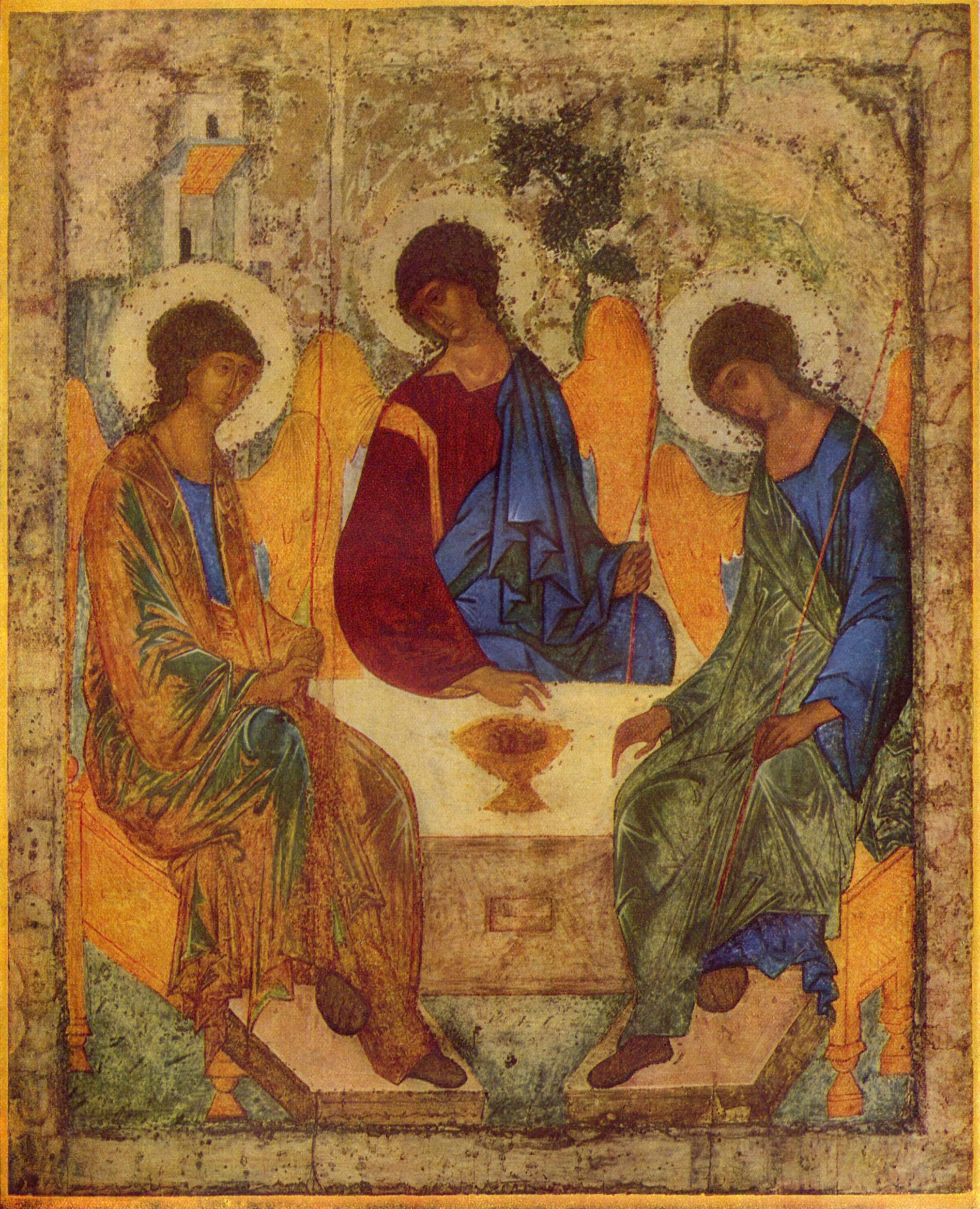
However, from the very beginning of Creation, the presence of the Holy Trinity has been hidden from the believer. The Father, who is the creator, is selfless and shares creation with humanity. He is present with the Son as the Word through whom all things came into the existence, and of course the Spirit as the wisdom of God. In Genesis 1:26, there is the presence of more than one person involve in creation. God the Father said, "Let us make in our image." Here is a small evidence that the presence of the Holy Trinity had already existed from the very beginning of time. Moreover, the presence of the Trinity reappears in the scene of  Abraham by the Terebinth (Gn. 18:1-2). Abraham looked up and saw three men whom scholars claim is the presence of the Holy Trinity.

All this, leads one to discuss that each person in the world is a reflection of the Holy Trinity. When God the Father created Adam, he loved his Son so much that he took the image of His Son to create Adam. In addition, He breath into Adam's nostrils life and gave him the Spirit. Imagine, the love of God is reflected in the first human being to be righteous and holy like the Trinity. However, the image and likeness of God became tarnish; for this reason, God sent his only Begotten son to reveal the hidden presence of the Trinity and from where Adam's image came from. In John's Gospel, Jesus, who is the second person of the Trinity, heals a blind man and puts dirt and saliva onto his eyes (Jn. 9). The man recovers his eyesight, but he realizes that he could see and sees Jesus. Although he does not recognize from where his image and likeness comes from, the image and likeness of humanity comes from the Son.

Our entire life has to reflect the image and likeness of Christ here on earth while imitating his example, and hopefully we could come to reflect his passion, death, and resurrection. He has come to reveal the hidden presence of the Holy Trinity by once again uniting us to the Father through the Holy Spirit. His death brought about the unity that once kept humanity apart from his creator. Today, we have been blessed to see where our true reflection comes from, and we must look like him on the cross and resurrected from our graves. May this inspiration draw us closer to the mystery of the Holy Trinity.        

Friday, February 20, 2015

"Lord, Son of David, have mercy on me!" (Mat. 15:21-28)

The woman is a Canaanite. The Canaanites were known to defile the land of Israel with their idolatry and pagan practices. In fact, the Canaanites could be traced back to line of Cain. After the flood, Noah had three unmarried sons, and one of those sons were Canaan. In addition, Abraham traveled through the middle east and one of the pieces of land he bought was in Canaan.

In Genesis 10:15, "Canaan became the father of Si'don."Here is a connection with Jesus traveling to Tyre and Sidon. The tree commentary Tyre and Si'don is located north of Palestine.

In the Gospel of Matthew, Jesus is traveling to neighboring towns proclaiming the Good News. He has just finished talking about impurity and what defiles a person in chapter 15. Next, he hears the screams of a woman that begs Jesus to listen to her request. However, Jesus says something astonishing to the Canaanite woman, since the Canaanites were considered to be immoral people. In addition, they also represent the gentile Church that has been excluded from the kingdom of God. On the contrary, the woman knows that Jesus is a holy and righteous man, but this does not stop her from pursing and begging Jesus to listen to her request.

The Canaanite woman cried out to Jesus, "Have mercy on me, Oh Lord, Son of David." These words of mercy and recognition before Jesus that she does not consider herself to be worthy or upright before eyes. Unlike the Pharisees and Sadducee's who never recognized their sinfulness nor beg Jesus for mercy and petition. However, Jesus did not answer her a word. The question remains open. Why would Jesus not say a word to the woman who was pleading for a miracle?

The Canaanite woman petition for her daughter to be free from a demon. Scripture does not explain what kind of demon she had, but she might have had a demon that was leading her to commit a sin. However, she did not give up on her persistent toward Jesus for scripture attest, she was crying. The Canaanite woman reveals a repented heart, a turning away from sin towards the living God who forgives and restores back to life. The disciples are blind to this reality that the woman out of heart cries out with a contrite heart and Jesus could see this. As a result, the disciples are embarrass for this woman's behavior and begged Jesus to send her away.

Jesus responded, "I was sent only to the lost sheep of the house of Israel."Jesus was not trying to discourage the woman from her persistence in asking for a miracle, he let her know that Jesus is the good shepherd and seeks out the lost sheep. Canaanite woman is the lost sheep and she listens to the voice of the shepherd. She turns away from sin and turns to the answer for her problem.

Her persistence led her to do the impossible something that the Israelite's were not able to do. Scripture says she came and knelt before him. Her body posture and reverence to the Lord of Lords, and King of Kings demonstrates her humility and recognition that she needs a savior and Jesus is the answer. For Holy Scripture says, "Return, says the Lord, I will not remain angry with you; For I am merciful, I will not continue my wrath forever. Return, rebellious children, says the Lord" (Jer. 3:12b, 14a). Thus, the woman says, "Lord, help me." She expresses a sign of repentance and she recognizes her weaknesses before God. For this reason, Jesus says to her, O woman, great is your faith!"

In this Lenten season, we are called to imitate the life of the Canaanite woman that seeks the Lord in humility. She recognized her sinfulness and cries out to Jesus for mercy and love. Jesus remains silent, but he does not despised her petition. She demonstrates a contrite heart by crying to him to help her overcome the demon her daughter had. Then, she teaches us how to obtain the blessing, she knelt down and beg the Lord.

Thursday, February 12, 2015

The American Lie: "You Could Be Anyone You Want."

In America, secular society states that any person could be who they want to be as he or she grows up. Back in the ninedies, Michael Jordan became the center and inspiration for all the citizens and non-citizens in Chicago. He had outstanding skills and movements while playing basketball; he capture the attention of many viewers. As a result, gatorade put out a phrase, "You could be like Mike." In addition, there were songs that had a phrase, such as "Like Mike, I could be like Mike!" This is not true; although, being who you want to be is part of the American ideals. The point is that one cannot be like Michael Jordan because Jordan is a reflection of himself. Society was promoting a reflection of the self and not a reflection of God. 

In Genesis 1:26, the author states that God says, "Let us create man in our own image and likeness." Here there is the existence of more than one person acting in creation. Man was created to reflect the image and likeness of God. After the fall, man became the reflection of himself instead of God. He lost his identity and reflection throughout history. 

The Church Fathers zero in on the account of Creation. St. Irenaeus gives a commentary on Genesis 1:27 by recalling what Christ did in the book of the Gospel of John. Jesus heals a blind man. However, the man was born blind, and many people thought that this blind man was born with sin. Although the Jewish thought was right that each man was born with sin, he was the instrument in how Jesus will repeat the same action from the beginning of Creation. Jesus repeats the same actions as he saw his Father do in the moment of creation. Jesus takes mud and spits on it and then he smears mud on the eyes of the blind man. The blind goes off and washes in the pool; he goes to the temple, and he becomes interogated; but eventually gets kicked out. Jesus appears again, and he says, "Do you believe in the Son of Man? the man says, "Who is he, sir, so that I may believe in him? Jesus says, "You have seen him, and it is he who speaks to you." Society continues to be blinded by the truth of who the person truly is. We are called not to be reflections of the self, but to be icons and reflections of Jesus Christ. 

Thus, each person is unique and different because God created us differently. We are called to reflect the image and likeness of Christ onto others, The moment our eyes are open to this truth of where our creation comes from, it is the moment when we could reveal onto others the love of God. Being an icon means to reveal the love of Christ in generosity, service, and love onto to others who are hungry for truth. 

Saturday, January 10, 2015

Wisdom Be Attentive

I was getting ready for morning prayer, and I was drawn to a scripture verse. The Holy Spirit began to speak to me through the author of the book of Wisdom 7:26-27. Wisdom is view in a feminine way. She is the that has eternal light for the mind; She is the mirror of the power of God; She is goodness; She makes all things new; She guides men and women in the right direction; and she produces friends  for God and prophets.

As I read through this and contemplated on the Word. The Wisdom that the author is talking about is the Holy Spirit. The Holy Spirit passes on to the minds and hearts of the people in order to prepare the way to eternal happiness with the Trinity. One thing is certain, the author points out that the Holy Spirit makes friends of God. Enoch, in the book of Genesis, was filled with the Holy Spirit and walked with God. He walked faithfully with God by listening to the voice of Wisdom that passes on to souls that are willing to grow in holiness and righteousness all the days of their lives. Then, Enoch was taken up to heaven because God took him away.

In the same way, God speaks to us each day in different circumstances in order to walk with him on the right path just like Enoch. He, the holy Spirit, continues to renew us, so that we could be taken up with God as we walk with him. May the Holy Spirit continue to reveal the wisdom of God in order to be reflections of God' friends in the midsts of our journey towards Heaven.

The Gateway to Jesus

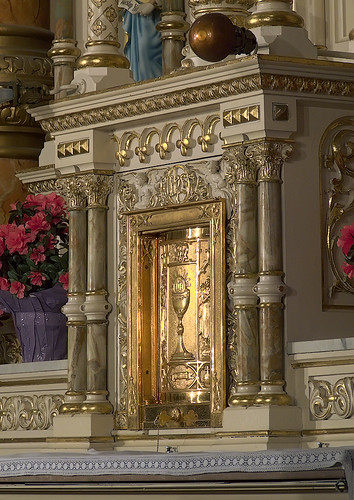
Every Catholic Church has a tabernacle either in the chapel or in the center of the sanctuary. Before one could get close to the tabernacle, one would have to walk through the sanctuary doors. The doors of course remain locked and are open for the Divine Office or some liturgical celebration. The doors have keys, and so does the tabernacle. A key represents access to something that is forbidden or unable to trespass into another area. In the Gospel of Matthew, he records a parable about the ten virgins. He says, "Here is the Bridegroom! Go out to meet him."

In the Seminary community, the seminarians go out of their rooms in haste to prepare for Mass and Adoration. They go out of their rooms to have an encounter with someone that is about to meet them. They seat at their assign seats as the celebrant and alters servers stand at the back of the entrance of the sanctuary doors.

The doors represent the entrance towards the next step to encounter someone. Although the seminarians, servers, and celebrant might not be fully aware who is coming to meet them, the setting for the preparation is ready with incense, hymns, and prayers. After the consecration of the bread and wine, someone becomes present and visible.

However, there is still another place that needs to be open in order for the celebration to continue. The Deacon or the acolyte make their way to the tabernacle and has a key on his hand to open the door. The door is open and remains open until the he places sacrament back at the tabernacle.

Matthew knew exactly what Jesus was saying when he said, " The bridegroom is here! go out to meet him." The seminarians along with the servers and celebrant go out and meet Jesus in the Divine Office. He becomes present in the Sacrament, the precious Blood and Body of Jesus Christ, to enter another place where he will make his dwelling.

In the Gospel of Matthew, Jesus talks about ten virgins that were wise. Five were foolish and the five of them were wise. The foolish ones did not have enough oil, so they asked the wise ones to share their oil. However, the wise ones did not share their oil knowing that it took them a long time to acquire such expensive oil. The Bridegroom sits in his kingdom, which is the Divine Office and the tabernacle, and the doors are locked. The doors become open once the celebration occurs and Jesus himself walks through the streets of the world in search for those who are ready to receive him. The five wise virgins had oil that kept their lamps burning all night; the light represents the Gospel of Jesus Christ shining in the darkness of the world. The other foolish ones ran out of oil and allow the darkness of the world to overcome the light of the Gospel in their lives.

John, in the book of Revelation, utters the words of Jesus, "I stand at the door and knock. If anyone hears my voice and lets me in I will dine with him." When the bridegroom comes out to meet us, He knocks at the gates of our hearts and dines with us when we receive his Precious Body and Blood into our hearts and minds. He fills our cups with oil and keeps the light shining in the darkness in order for others to see. Thus, the only gateway to Jesus is to follow the light that burns every night near the tabernacle, which is called the sanctuary light. Let us be those sanctuary lights so that when the bridegroom comes, we too may go out and meet him.

Sunday, December 28, 2014

God Breaks Through The Darkness

During Christmas Vigil, the manger was empty, the longest night was evident, and the people waited for God to come down. The celebrant, along with the altar servers, was processing in with songs of praise and incense rising to the rooftop. People were waiting for an answer to their darkness and difficult situations. The Word was being proclaimed as the people listen attentively; the Gospel was being chanted as the people listen attentively; the homily was preparing the people as the people listen attentively. Then, something extraordinary happen during the liturgy and God shined his light in the hearts of the people. 

The psalmist expressed the manifestation of God's glory in a beautiful image. He says, "In the morning you will see His Glory. The dawn from on high shall break upon us" (103:1). The soul praises God when he or she sees the Glory of God shining in his heart. After the homily, the celebrant calls the server to bring out that that was hidden before the beginning of time. The server has in his hand the infant Jesus, the Word made flesh. The people looked intently as the manger was empty and now is were once filled with God's presence among the people. 

The Prophet Isaiah once again tells the people in the liturgy to rise from their darkness and welcome once again the Word made flesh. He says, "Awake and put on the glorious garments--shake off the dust of the unclean and immorality”(Isaiah 51-52). Augustine too says, " Awake! For God became man. For how could there be peace on earth unless truth has arisen from the earth, that is, unless Christ were born of our flesh? And he is our peace who made two into one; that we might be men of good will, sweetly linked by the bond of unity."


The Word made it's dwelling when the people knelt before the infant Jesus. During the profession of faith, the people of God professed their faith and something extraordinary happen. The people along with the celebrant knelt from the opening until the part where it says, "And He came down from Heaven, and became man." This pivot moment became the experience for each individual to awake from their sleep, arise from their darkness, and allow the King of Kings to dwell in their hearts once again. This very moment prepared the heart of the person to allow Christ to come into their hearts with the final moment in the Eucharist. God, who was present in the Eucharist in a very humble way, enters the heart of the person and reveals his hidden Glory and presence to the person.

The Dwelling Place of God


The Apostle Paul talks about trials, distress, persecutions, and sins. He touches on key points that most people encounter on a daily basis in life; some of these people are bombarded with a deep darkness without any hope or faith in life. Look at what the Apostle Paul says, " Blessed be the God and Father of our Lord Jesus Christ, the Father of mercies and God of all comfort, who comforts us in all our affliction, so that we may be able to comfort those who are in any affliction, with the comfort with which we ourselves are comforted by God." Paul has the assurance that God will comfort those who put their trust in Him. The darkness covers the person whenever God is no longer in the heart. At times, trials, tribulations, and spiritual battles can seem that God is not present or alive. These past weeks of Advent, there were scripture verses that elaborated on the Word of God. The prophet Isaiah speaks the Word of Lord by saying, "The heavens are my throne and earth is my footstool what kind of house shall you prepare for me. 

In the book of Psalms, the Psalmist believed that the dwelling place of God resided in the temple of Lord in Jerusalem. Jerusalem was the place of focus and worship for the all the Israelites. They saw Jerusalem as the dwelling place of God's presence among them. However, the presence of God throughput the Israelites history remains on the outside of their lives. For instance, in psalm 102, he asks God to listen to his prayer in times of darkness and distress. His prayer and anguish was occurring within the person, and God was not within the depths of his heart. He cries out in humility for aid and he places his trust on the lord. He says, "O Lord, listen to my prayer." This statement is an expression of anguish and abandonment of the presence of God in times of trials and darkness. He goes on to say that he feels like "an owl in a desolate place, a pelican in the wilderness, and a lonely bird on a roof." The psalmist had not yet experience what most people experience today in the world. 

However, he has hope that the presence of God will once again appear before his very eyes. Now, he had no idea in which way the presence of God was going to be revealed and how it was going to be viewed or experienced by the individual. He says, " God will turn his face when his glory appears." Of course, the Israelites saw the glory of God through tangible signs, such as a pillar of fire, a cloud covering the sanctuary, and lightning and thunder descending from the heavens. Furthermore, the Psalmist continues to focus on the external presence of God because he states that God looks down from heaven to listen to the groans of the prisoners.

The prisoners are those who long to see the glory of God as the wait in hope for his coming. Isaiah prophesied that God would restore the desert into the Garden of Eden (51:1-11). He says, "joy and gladness shall be found in her. Then, the prophet utters out "Awake, awake, put on strength, O arm of the Lord." The psalmist too states, "Lower your heavens and come down; touch the mountains; wreath them in smoke. Flash your lightning; rout the foe, shoot your arrows and put them to flight. Reach down from heaven and save me; draw me out from the mighty waters, from the hands of alien foes, whose mouths are filled with lies, whose hands are raised in perjury" (psalm 144:1-10).

The Word of God spoke through the prophets in varies ways. Although the presence of God was manifested, God does something different during this Advent. He comes down from heaven in his word, who is Jesus Christ becoming man. He makes his presence known to man by announcing the Good News that he became man to dwell among us. Not as something external when the person sees the infant on the manger, but as an indwelling within the heart of the person. The indwelling takes place as soon as the person prepares his heart to welcome the living God who became vulnerable, humble, and an infant for the sake of each person. 

Thursday, November 27, 2014

The Reality of the Journey of Faith


In the letter to the Corinthians, St. Paul writes about the reality of the trials and challenges that a Christian must endure for the sake of growth and sanctification He says "None of the trials which have come upon you is more than human being can stand. You can trust that God will not let you be put to the test beyond your strength, but with any trial will also provide a way out by enabling you to put up with it."God allows trials and challenges to occur for a reason and a purpose. Although the trials and challenges are unknown in the moment, St. Paul, nevertheless, claims that trial builds endurance and character. In the trials, God gives the strength to endure the trials. I would like to focus on a given topic regarding out present stage. I bring up the view of trials for a reason in order to question the manifestation of grace in life.

            Being born into original sin, the doctrine is about the disobedience of Adam’s sin. After the fall, man lost his total innocence and communion with God, which is called original justice. Original justice is the perfect of state of being where everything in creation and humanity is in perfect harmony. In addition, original sin deprives the person from having eternal life. The Fathers of the early Church touched on the doctrine of original sin and what were the effects in humanity. Fathers, like Augustine, claimed that the person that was not baptized went into limbo. Pelagius in the fifth century did not believe in the doctrine of original sin, and he believed that original sin had no longer a griped on humanity. He thought that humanity was not flawed or fallen because of original sin; he believed that humanity had a free will to choose to follow the Ten Commandments, and that the sin of Adam had no affect on humanity. The person, because of his free will, has the power to chose to sin, and it is only then when man is responsible for his own sins. Augustine, of course, shot down the argument, in the fifth century; he thought Pelagius had good ideas and intelligence to expose his knowledge, but he fell into error by denying the fact of the reality of human weakness and fallen nature. Augustine stated that even though babies do not have the free will to sin because of their reason, they still are born with original sin because of selfishness that exists from birth.

            The Apostles and the Church Fathers proclaimed that baptism is necessary for salvation; without baptism, man cannot be saved. Until this day, Protestants and non-Catholics continue to ask the question whether a non-baptized baby could be saved. In baptism, original sin is removed from the sinner, the holy spirit is given, the cleansing of other sins are removed, becomes an adopted child of God, and has full communion with the Holy Trinity. Here we realized that God removes all of sin from the sinner, but there is still something remaining in human nature. That is, the effects of original sin remain alive in the person, such as the daughter of original sin, namely, concupiscence. Augustine and other Fathers of the Church talk about concupiscence as the unruly appetites of the person or disorder love. She dwells in the members of the body and ignites unruly passions like lustful desires. Grace, however, is given in baptism and other sacraments to conquer her in every way possible. In addition, grace gives the person the aid to have self-control and grow in virtues daily.

            My argument is based on the constant struggle that man is faced with daily in his humanity. God allows these trials and challenges for a common reason that at times is unknown to the person. God knows exactly in what areas the person needs to grow to become the person that God wants to see. But why would God allow a sinner to endure trials and challenges and struggle if he or she has already repented, accepted Christ, baptized, confessed, and desires not to abandoned God? This question many have many answers from different people. But the fact is that what remains is the very selfishness of original sin—Adam from the very beginning was created as self to reflect the image and likeness of God to serve, to love, and to know his creator. I think there was a shift from the self-mirroring image of God to the self-mirroring of possession wanting to a god.    


[1] 1 Corinthians 10:13. All Scripture verses are from the RSV

Thursday, September 25, 2014

The Priest We Do Not Know


The priesthood has its evolution throughout time and history. The existence of the priesthood goes back to ancient times when primordial religions existed. History unfolds and reveals that there is a development in priesthood that has been influence by primordial tribes. Nowadays, people are no longer interested or influence by the priesthood. In fact, non-Catholics do not know what a priest is or what he represents in the Church and society. Thus, the fabric of what it means to be a priest was withered from the minds of modern era. On the other side, Catholics as well as Orthodox and Byzantines communities have kept the identity of the early church alive in their communities, but unfortunately, people who have not grown in a Catholic community have no idea or influence of what the priesthood represents and its important influence in the lives of others in family, community, and society. To help others know about what a priest is and how it has been established by Jesus Christ, one must traced the priesthood back to its origin to fully understand where the priesthood comes from.

The Primordial Priesthood

The priesthood was a common practice and way of life throughout the Eastern World. In Egypt, the pagan temples had priest and priestess, who were responsible to fulfill the duties of worship to different deities. The pagan priest made sure that the worship and presence of a particular god was being celebrated. Moreover, there was the presence of a high priest in the country that governed the community of priests to ensure that the religious duties were celebrated. Because of the religious affiliation over the people and politics, the priesthood became very powerful and began to increase. In addition, the priests had a great influence and prestige in the country as well as politically. According to Marie Parsons, a researcher in Egyptian Archeology, the priests played an important role in the economy and government, which gave them power to influence the Pharaohs.” They also performed other kinds of duties, such as administrators and record-keeping. Above all, they were called "servants of the god.” http://www.touregypt.net/featurestories/priests.htm Because of this, the priesthood was raised to a higher standard in society by Pharaoh, who later became High Priest during the 20th Dynasty.

The First Sign of the Priesthood in Ancient Times 

On the other hand, the identity of the priesthood goes back much further than the Egyptian times. The narrator of Genesis talks about a mysterious figure that appears as a priest of God Most High (Gn 14:17-20). In the picture, Abraham is kneeling before the priest. The priest is known as Melchizedek. He was the king of Salem, and Salem was known to be the ancient name for Jerusalem. When Abraham defeated his enemy and saved his nephew Lot, Melchizedek offered bread and wine on behalf of Abraham to God. As a result, Abraham gave him a tenth of his shares as act of gratitude to God because Melchizedek was the mediator to God. Abraham knows that Melchizedek was a representative of God. According to the Torah Commentary, Melchizedek was a representative of all the pagan gods in the region, and he worshiped the One true God overriding the rest of the pagan gods in the area. Thus, Abraham worshiped the same God that Melchizedek worship during his time. 

The priesthood, however, began to emerge within the tribe of Levi throughout time. In the book of Genesis, Leah, who is the wife of Jacob, conceived three sons. Her last son was called Levi, meaning he will cling. Levi committed a serious sin by killing Ha'mor and his son Sche'chem (Gn 34:26). Later, Jacob calls his sons together and says, "Simeon and Levi are brothers; weapons of violence are their swords (Gn 49:5). As the family remained in land of Goshen in Egypt, the descendants of Levi began to multiply within their own community, but they have not obtained the title of Priesthood yet. The identity begins to unfold when Moses was born from the tribe of Levi. According to Exodus, Moses was raised by Pharaoh's daughter and than becomes an important character, leader, and guide for the people of Israel (Gn 2:1). Moses became the messenger of God, and the one who reveal the true God to the people of Israel, "I am who I am." He had a special calling from God to deliver the Israelites from the hands of Pharaoh. Moses accomplished everything that Lord had commission him to do. Although God never called Moses a priest or referred to him as a priest, Moses celebrated and performed the religious duties that the priest would have to follow in order to enter the holy sanctuary, such as offering sacrifices, reconciling the people from their sins, peace and cereal offerings, and consecrating the first born to the Lord. Since Moses came from the tribe of Levi, he stills forms part of the priestly class. In fact, the Lord called Aaron, who is Moses' brother, to serve as a priest in the Liturgy. He says, "Then bring near to you Aaron your brother, and his sons with him, from among the sons of Israel, to serve me as priests— Aaron and Aaron's sons, Na'dab and Abi'hu, Elea'zar and Ith'amar" (Ex.28:1). Here is the beginning of ordained ministers for God to act out the duties of public worship for the people. They became the instrument that God used to unite humanity back to God in accordance with His covenant.  

The Inheritance of the Priesthood is Designated by God. 

After the Israelites have committed apostasy, Moses spoke to the people and said to make a choice either to be against him or with him. Once the Levites heard the declaration by Moses immediately they took Moses side and three thousand men fell on that day (Ex. 32:26-28). The Levites, then, began to form an identity from the rest of the Israelites. The Lord spoke to Moses and said, "Bring the tribe of Levi near, and set them before Aaron the priest, that they may minister to him. They shall perform duties for him and for the whole congregation before the tent of meeting, as they minister at the tabernacle (Num. 3:6-7). 

The Levites not only form part of the priestly class, but they had a new identity within the people off Israel. Aaron is considered the first priest in the tribe of Israel because he too was from the tribe of Levi. When the Lord called Moses and Aaron to serve as priests, there was a rite for ordination. First, Moses is the principle celebrant of the ceremony. God calls Aaron and his sons through Moses to participate in God's Priesthood. The ceremony will last for seven days as they offer sacrifices to the Lord on behalf of Moses, Aaron, and his sons. During the week, Aaron and his sons will perform purity rituals, which consists of washing. Next, they will be clothed with priestly vestments. Following, they will be anointed by Moses, and they will offer animal sacrifices and cereal offerings in order to be sanctified (Ex.29). With all this being said, the priesthood was set apart for the tribe of Levi. They had to continue their office as priest to serve the Lord and no one was able to become a priest unless he was connected to the tribe of Levi.   

The Priesthood in the New Testament

In the New Testament, the word priest was not used to describe the priesthood that exists today. In fact, Jesus himself did not use the word priest or high priest. There is evidence within Jerusalem that there was a chief priest and a High Priest in the temple. The High Priest was Cai'aphas, who was the son in law of Ananias, a High Priest. Cai'aphas was considered the temple priest at that time that represented the entire of people of Israel. Since the Israelites were under Roman authority, they did not have a legitimate King or heir for the throne. In fact, they were still waiting for the political Messiah to arrive. Again, from the comparison of the Egyptian political system when the High Priest became the central figure of power, leadership, and influence over society, the political system in Jerusalem becomes evident again, where the High Priest and chief priest had a lot of power, control, and influence over the people. 

In Gospel of Luke, Luke points out in his first chapter that Zechariah was a priest. Zechariah, who was from the tribe of Levi, had an epiphany while he was offering incense. The scene reveals the appearance of the angel Gabriel, who is God's messenger. In the encounter with the angel, the practices of the priesthood continued to be celebrated in the same way that was revealed in the Old Testament. Luke says, "according to the custom of the priesthood, it fell to him by lot to enter the temple of the Lord and burn incense" (Lk 1:9). This shows clearly that the presence of the priesthood was still eminent in Jerusalem. As the angel delivers his message, he tells Zechariah that John the Baptist will come in the Spirit of Elijah to prepare the coming of the Lord. To point out something interesting, could it be that John the Baptist also identified himself as a priest before the Scribes, Pharisees, Sadducee's, and the Chief Priest in Jerusalem? Or could it be that his involvement in religion and the priestly system, that existed, caused him to counter act towards the corruption that existed in the political system that affected the priesthood? John the Baptist spoke with harsh words towards his adversaries, and he does claimed to be a Prophet who prepares the way for the Lord Jesus. However, there is evidence that John the Baptist is from the tribe of Levi, since every first-born male had to be consecrated to the Lord. With this being said, not only is John the Baptist a prophet, but he is also a priest that calls people to repentance and sanctification for the glory of God.

Moreover, Mary, who is the mother of God, gives birth to the Son of God. Now, the genealogy of Mary also is another aspect that connects Jesus to the Priesthood. The angel informs Mary that her relative, Elizabeth, is six months pregnant (Lk 1:36). Here, there is evidence that the family of Mary is within the priestly class. The reason for this speculation is that the priestly class was not allowed to marry outside of the tribe. The connection exists with Mary giving birth to the Son of God within two lines of history, the priesthood, and the Davidic dynasty. Joseph, who was betrothed to Mary, was from the line of David, which connects Jesus to the line of Kingship and fulfilling the promise of God. In addition, Mary lineage is traced back to the tribe of Levi, which connects Jesus to the Priesthood. 

In the Gospel of John, Jesus never calls himself a priest, but his words connect him to the events that occurred in the Old Testament. John records the words of Jesus by saying, "I am the living bread* which came down from heaven; if any one eats of this bread, he will live for ever; and the bread which I shall give for the life of the world is my flesh." Here Jesus is identifying himself as the living sacrifice for the sake of all of humanity, but he also points to an event that occurred in the wilderness with the Israelites. "Then the LORD said to Moses, "Behold, I will rain bread from heaven for you; and the people shall go out and gather a day's portion every day, that I may test them, whether they will walk in my law or not" (Ex. 16:4). The manna was reserved and placed inside of the Tabernacle along with the staff of Aaron that represented the Priesthood, and the Ten Commandments. Jesus states that He himself is the bread that comes down from heaven, but he comes down from Heaven and makes his dwelling in the womb of the Virgin Mary. In the womb, Christ becomes Bread as the Sacrifice that will be offer to the Father; he also is a priest as the one who represents the Priesthood of Aaron; and He represents the Ten Commandments because he is the Law giver and fulfillment of the Law in Old Testament. 

Likewise, Jesus is the victim and sacrifice for the sake of humanity. He offers his own humanity that was received from Mary, to be a living Sacrifice for sins of mankind. He fulfills the role of victim as he suffers in His Passion and crucifixion. His Sacrifice on the cross replaces the old sacrifices in the Old Testament. The author to the Hebrews says,  "Sacrifices and offerings you have not desired but a body have you prepared for me" (Heb 10:5). The priest in the Old Testament had to offer sacrifices and offerings to God before they entered the Holy of Hollies. Jesus offers His own Body and Blood as a living Sacrifice too enters the holy of Hollies’. Even though he was human and experience suffering and pain, he committed no sin. The author to the Hebrews states that he was tempted like every human being but committed no sin: "For because he himself has suffered and been tempted, he is able to help those who are tempted (Heb. 2:18); For we have not a high priest who is unable to sympathize with our weakness, but one who in every respect has been tempted as we are, yet without sinning" (Heb 4:15). Jesus triumphed over temptation as man (Mt. 4:1-11). Thus, Jesus' Sacrifice replaces all sacrifices in the Old Testament once and for all. He offered his Body and Blood as the Perfect Sacrifice for the remission of sins. 

The Early Church and The Identity of Priesthood:

When Jesus Christ rose on the third day, He appeared to the Twelve; but he first appeared to Mary Magdalene. The apostles already had a mentality that was prophetic, kingly, and priestly. Before Jesus ascended to heaven, He commissions his Apostles to do everything that He thought them: 

And Jesus came and said to them, "All authority in heaven and on earth has been 
 given to me. Go therefore and make disciples of all nations, baptizing them in the 
 name of the Father and of the Son and of the Holy Spirit, teaching them to 
 observe all that I have commanded you; and behold, I am with you always, to the 
 close of the age. (Mt 28:18-20)

Peter, who is the first Pope, receives the authority that is also shared with his Apostles, the college of bishops. This authority is given by God himself to govern his Church on earth, but it is also to exercise his kingly role by guiding His Church on earth through Peter. The priestly role is to administer the sacraments (Baptism, Eucharist, and Confirmation) and sanctify the people by the forgiveness of sins. The prophetic that Peter takes upon himself is to teach the people of God the Gospel and proclaim anything that is contrary to the teachings of Christ. Although the Peter and the Apostles never called themselves priest, they did use the word Priesthood to emphasize their identity with Christ. 

For instance, St. Paul, in his letter to the Romans, says, "To be a minister of Christ Jesus to the Gentiles in the priestly service of the gospel of God, so that the offering of the Gentiles may be acceptable, sanctified by the Holy Spirit" (Rm 15:16). Paul's role, as an ordained minister who was chosen and called by God, performed priestly duties, which was to teach (prophet), sanctify (priest), and govern (king) the baptized community. In addition, he wanted to imitate Jesus so much that he himself wanted to be a victim like him. He says, "Even if I am to be poured as a libation upon the sacrificial offering of your faith, I am glad and rejoice with you all" (Phi. 2:17). Moreover, his life resemble the sacrifice of Christ on the Cross when he says, "Now I rejoice in my sufferings for your sake, and in my flesh I complete what is lacking* in Christ's afflictions for the sake of his body, that is, the Church," (Col. 1:24). 

On the other side, St. Peter also used the word Priesthood to identify himself and the community like this: "and like living stones be yourselves built into a spiritual house, to be a holy priesthood, to offer spiritual sacrifices acceptable to God through Jesus Christ" (1 Pt. 2:5). Such spiritual sacrifices were the sufferings that each member had to go through by giving witnessing to the Gospel. Thus, each member and head were considered to be icons of Christ on the cross in order to imitate Jesus as a priest. 

Jesus the High Priest

Although Jesus never called himself a priest, there is a place in the New Testament where it states that Jesus is a priest. In the letter to the Hebrews, the author states, So also Christ did not exalt himself to be made a high priest, but was appointed by him who said to him,"You are my Son, today I have begotten you"; * as he says also in another place, "You are a priest for ever, according to the order of Melchizedek." 7 In the days of his flesh, Jesus offered up prayers and supplications, with loud cries and tears, to him who was able to save him from death, and he was heard for his godly fear. Although he was a Son, he learned obedience through what he suffered; and being made perfect he became the source of eternal salvation to all who obey him, being designated by God a high priest according to the order of Melchizedek. (Hb 5:5-10) Thus, the mysterious figure that appears in the book of Genesis now reappears again. Jesus, who appeared to Abraham, is the High Priest that represents the True God of Israel. He also calls himself the Good Shepherd. In the Gospel of John, Jesus calls himself the Good Shepherd that is willing to lay down his life for his sheep. He becomes a victim fulfilling Isaiah where he talks about the Suffering Servant. The Suffering Servant in Isaiah 53 illustrates the suffering he had to endure "like a lamb led to the slaughter." Jesus not only fulfills the role of the High Priest, but he enters through the sanctuary with his own blood. Luke states, "It was now about the sixth hour, and there was darkness over the whole land until the ninth hour, while the sun's light failed; and the curtain of the temple was torn in two" (Lk 23:44-45). The spotless and acceptable Sacrifice of Jesus allows him to enter the Temple's sanctuary on earth and in heaven. The psalmist gives a good description when Jesus ascends onto heaven because the angels could not recognize who He was: He says,

    Lift up your heads, O gates!
   and be lifted up, O ancient doors!
   that the King of glory may come in.
    Who is the King of glory?
   The LORD, strong and mighty,
   the LORD, mighty in battle!
    Lift up your heads, O gates!
   and be lifted up,a O ancient doors!
   that the King of glory may come in.
   Who is this King of glory?
   The LORD of hosts,
   he is the King of glory! Selah (Psalm 24)


Furthermore, Christ enters Heaven with Priestly garments. For every high priest, according to the Law, had to offer sacrifices for his sins and the people to enter the Holy of Hollies. He also had to wear priestly garments in order to represent the Priesthood from the time of Aaron. Christ enters heaven in priestly garments and establishing a new covenant. The letter to the Hebrews states as follows,

This makes Jesus the surety of a better covenant. The former priests were many in number, because they were prevented by death from continuing in office; but he holds his priesthood permanently, because he continues forever. Consequently, he is able for all time to save those who draw near to God through him, since he always lives to make intercession for them. For it was fitting that we should have such a high priest, holy, blameless, unstained, separated from sinners, exalted above the heavens. He has no need, like those high priests, to offer sacrifices daily, first for his own sins and then for those of the people; he did this once for all when he offered up himself. (Heb 7:22-28)

The Priesthood of Today

The priesthood of Jesus Christ continues to this day. There has been an apostolic succession from the time of the Apostles up to the present moment with Pope Francis who represents Christ here on earth. Most people who are not Catholic will be understand the primacy of Peter unless they become open and study the history of the Church and how that authority has been handed down from one generation to the next. The Priesthood of Jesus continues to be exercise here on earth in a new and radical way through the ordained priest in the Catholic Church and Eastern rites. The priest does not repeat the sacrifice of Christ on the Cross-in a bloody manner, but he makes present the Sacrifice of Christ on the Cross-that unites all people to enter into a new covenant relationship. Jesus, himself, becomes present in the priest, who is ordained, to make a new covenant with his people in a very personal way. May God continue to enlighten us as we search deeper into the mystery of his love reveal in his Church and the people.